


What is your love language? For some, it’s learning a new one! Meet a group of CRLC students who have been inspired by love to learn a new language. From weddings to in-laws to communicating in loud spaces, our students share why they began studying a new language and how it has helped their relationships.
HANNAH KAPADIA: Spanish

Age: 30
Town: Duanesburg, NY
Job: US Healthcare Policy Consultant, McKinsey and Company
What motivated you to learn Spanish?
My husband is Cuban-Spanish, and Spanish is the first language of his entire family. One of his siblings now lives in Madrid, which we visit regularly, and when we spend time with his parents in Miami, we’re immersed in a largely Hispanic/Latino community. I wanted to be able to communicate effectively, and independently, with family members who speak limited English. While my husband has always been supportive, learning from a heritage speaker without broader immersion proved challenging.
As we began thinking about the future and potentially starting a family, it became even clearer that Spanish is a vital part of his culture and heritage that we want to nurture and pass on. I come from a dual-heritage household—my mother is Filipino and my father Pakistani—where English became the default language because there was no shared native language between them. Growing up, I always felt that something meaningful was missing, and I strongly believe that knowing the language(s) of your culture matters. Learning Spanish felt like a way to honor that belief, while also strengthening my connection to my husband’s family and heritage.
Had you studied it before?
I hadn’t formally studied Spanish before taking this class. I did, however, learn French at a young age and later pursued a minor in French language and literature in college. Having experience with a Romance language helped me adjust to concepts like gendered nouns and some familiar grammatical quirks—phrases like “I call myself,” “I have X years,” or “I have cold” made a bit more intuitive sense.
I originally began learning French while living in Canada, where it felt much more practical than it ever did in the U.S. I had long been interested in learning Spanish, but it always felt like an overwhelming personal endeavor—something I wanted to do “someday.” Taking this class finally gave me the structure and support to begin.
How has it impacted your relationship?
My husband was genuinely touched by my decision to learn Spanish and by the idea of sharing this part of himself with me. He’s been incredibly patient, supportive, and encouraging, especially with my many questions and frequent requests for him to slow down!
One of the sweetest surprises has been my mother-in-law’s excitement throughout this journey. She sends me Instagram videos of Spanish lessons, recommends accounts to follow, shares songs for me to translate, and encourages me constantly. Seeing how meaningful this effort is to her has made the experience even more special, and I’m grateful for the love and support surrounding me so early in my learning process.
Any surprises or other ways learning another language has impacted you?
One of the biggest surprises has been how emotionally rewarding the process has been. Learning Spanish has given me a deeper sense of belonging and confidence when spending time with my husband’s family, even though my skills are still very much a work in progress. It has also reminded me how vulnerable and humbling it can be to be a beginner, which has helped me become more patient with myself.
I hadn’t been a true beginner in a language in a long time, and learning as an adult has been a surprisingly positive experience. I find myself feeling far less unsure or insecure than I did when I was younger or in university. There’s something incredibly encouraging about being in a classroom full of adults who are all learning a new language for their own personal enrichment; it creates a supportive, motivating environment where curiosity feels more important than perfection.
What is your favorite word?
Not a specific word, but one of my favorite things in Spanish is the diminutive ending -ito or -ita. Adding it to a word instantly softens it or makes it more affectionate—sometimes smaller, sometimes sweeter, sometimes more personal. I love how such a small linguistic detail can convey warmth, familiarity, and care in a way that feels very natural in everyday speech.
Anything else you want to add?
Learning a language for love, romantic or familial, has been one of the most meaningful decisions I’ve made. It’s not just about words or grammar, but about connection, effort, and showing up for the people you care about. I’m still at the beginning of my journey, but it already feels incredibly worthwhile.
MEGAN TENETY STACKELBERG: Korean
Age: 57
Town: Schodack, NY
Job: Non-Profit Administrator
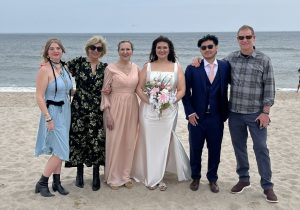
(In photo, Megan is second from the left)
What motivated you to learn Korean?
My sister, Brianne, married her true love, Seongk Yu, on the beach in New Jersey in April, 2025. She asked that my husband and I represent her side of the family in their Korean wedding this April.
I followed CRLC’s Facebook page awhile ago, and one day while mindlessly scrolling, I saw a student highlight. The student highlighted was learning Korean, and it inspired me to sign up for the next class – which started the following week!
Read the story that inspired Hannah to learn Korean!
Background: We are from the Jersey Shore, so the location of their 1st wedding was meaningful. Our father passed away in 2023, and Brianne’s mother – my stepmother – is in memory care and cannot travel. Therefore, Brianne asked me, as the oldest sibling, to represent the maternal side in their Korean wedding.
Have you studied it before?
No. Although when I travel I try to learn as much language and customs as possible in order to get by and be polite.
How has it helped your relationship?
I want to tell you how Brianne and Seongk Yu met. My siblings and I were reeling after our father’s death, and we healed together and in our separate ways. In April, 2024, Brianne ended a long term relationship and to clear her head she did a solo trip to Banff, Canada. When out to dinner one night, a singles social group appeared on scene and invited her to join them. She did and met Seongk Yu. He was working for a Korean shipping company based in Calgary. They spent the next few days together and fell in love.
My husband, Paul, and I are honored to be included in Brianne and Seongk Yu’s wedding. Paul will fill the role of our father in walking her to Seongk Yu in the ceremony. I look forward to being able to connect with Seongk Yu’s family better with my rudimentary grasp of Korean language. I also hope I can use what I learn to connect with my sister and her family.
My sister and I are half-related, sharing a father. I am the oldest and she the youngest, separated by 22 years. I graduated undergrad the year she was born, so our connection has really grown as adults in the last few years. Especially since our father’s passing and having to come together to manage all that entailed.
Any surprises or other ways learning another language has impacted you?
Korean is much easier to learn than expected. I appreciate that Hangul was created to make literacy available to all, regardless of education or background.
What is your favorite word or expression in Korean?
Bab meogia (let’s eat). I really enjoy Korean food!
SERENITY McCARTHY-ARNONE & CHRISTOPHER TATRO: American Sign Language
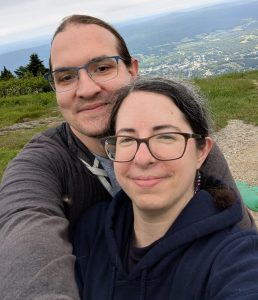
Ages: 36 (Serenity) and 40 (Tatro)
Town: Rensselaer, NY
Jobs: Physician (Serenity) and homemaker (Tatro)
What motivated you to learn American Sign Language?
We were looking for something to learn together. Tatro has worked in factories for many years and is developing some hearing difficulties from that so we wanted to have a shared way of communicating before that became more of a problem.
Had either of you studied it before?
Not formally. Tatro had a few Deaf friends in childhood so learned some from them.
How has it helped your relationship?
It has helped in big ways like communicating in loud airports as well as small ways like telling jokes while brushing our teeth at the end of a long day. Having a project to do together is important in a relationship. ASL has allowed us to focus our attention together and learn new ways that we approach the world as individuals and as a pair; it is our “third thing”.
To quote the poet Donald Hall, “We did not spend our days gazing into each other’s eyes. We did that gazing when we made love or when one of us was in trouble, but most of the time our gazes met and entwined as they looked at a third thing. Third things are essential to marriages, objects or practices or habits or arts or institutions or games or human beings that provide a site of joint rapture or contentment. Each member of a couple is separate; the two come together in double attention.”
Any surprises or ways learning another language has impacted you?
Given that ASL is American, we have been surprised to learn how much the language informs the culture of Deaf people. For example, eye contact is necessary for communicating in ASL, but in hearing culture prolonged eye contact can be off-putting. We also appreciate just how blunt ASL is as that is our preferred way of communicating.
What is your favorite sign?
Ignorant (there are a lot of variants!)
This is a link to a video showing the sign: https://www.youtube.com/watch?v=OzdEn_17wQA
SEAN KIM-BURNS: Korean
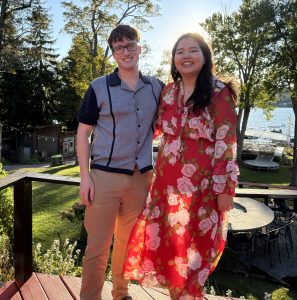 Age: 27
Town: Delmar
Job: Civil Engineer
What motivated you to learn Korean?
I was motivated to learn Korean because of how much work Michelle put into learning a second language, and how I wanted to pay it forward to her and put as much effort as she did to master it. I was also motivated by a desire to speak freely with her friends and family from Korea without having to use her as an interpreter.
Had you studied it before?
I had never studied Korean before being in a relationship with Michelle. As a matter of fact, I came in as a complete blank slate to the language, and everything I knew before learning at Capital Region Language Center was directly because of her.
How has it helped your relationship?
It has helped in that I am now able to engage in conversations with Michelle’s family and comprehend their responses. It has also helped with understanding and maintaining cultural norms in order to be respectful.
Any surprises or other ways learning another language has impacted you?
Learning Korean has had the effect of being able to express myself and communicate in ways I haven’t been able to before.
New languages mean new means of expression, and when you communicate in the language most comfortable, the effort is recognized and appreciated. It is how Michelle learning English benefitted me, and it is now how I am working to benefit her.
What is your favorite word/expression?
My favorite expression would have to be “알겠어” (algesso), which translates to an informal “I understand”. We also translate it to “I guess so,” which coincidentally sounds very similar between the two languages. As such, Michelle and I like to use them interchangeably for fun.
Anything else you want to add?
While learning a new language is difficult at first, it does prove to be a great way of breaking out of mental habits and challenging preconceived notions about the world.
The effort Michelle put into learning English motivates me even now to continue on the path to Korean mastery, and I will always be grateful to her for that.
JONATHAN FORWARD: Spanish
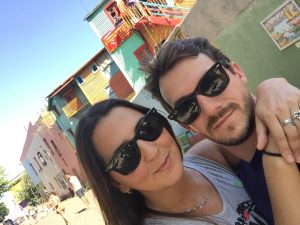
Age: Late 30s
Town: Albany, NY
Job: Engineer
What motivated you to learn Spanish?
I was motivated to learn Spanish because we want to have a bilingual family and I wanted to be able to communicate with Lucila’s family in their native language. We are also raising our two young children to be bilingual English/Spanish speakers from an early age. Our daughter just started at a biligual Spanish elementary school program (Albany International Academy – City of Albany School District).
Had you studied it before?
I studied Spanish for about three years in high school, so I had a foundation to build from, but it had been several years since I had practiced and learned in any formal setting.
I learned on my own here and there using other tools like Rosetta Stone and Duo Lingo, but I’ve found that a more formal method and instruction has kept me accountable and focused on improvement.
How has it helped your relationship?
Learning Spanish has helped with our family and social relationships. Every time we would travel to Argentina I would be immersed in the language and learn a lot, but I really wanted to work at becoming fluent. I feel like it really helps with my relationships with her family to be able to speak and understand everything when we are together.
I’d say one event which prompted me to begin classes was when my daughter started in her bilingual Spanish school, and I knew I needed to continue my education along with her in order to help her learn and to become bilingual myself along with our children.
Any surprises or other ways learning another language has impacted you?
I have been able to communicate more with other Spanish speakers who are complete strangers, and I think it often surprises them. I’ve also been able to help Spanish speakers who do not have great English skills by acting as a translator, if they are not understanding something, or having difficulty communicating with someone else in English.
What is your favorite word or expression in Spanish?
One of my favorite Spanish expressions was one I heard from my father in law: “Cocodrilo que se duerme es cartera” – which is an expression along the lines of – “You snooze you lose!”, but literally would translate to: the crocodile who sleeps becomes a purse!
I also love learning the Porteño Spanish slang of Buenos Aires, some of which can be a bit crude so I’ll leave those out. Some of my favorite Porteño words: Che! = Hey! (people say this all the time as a greeting or an exclamation); quilombo = a big mess, or chaos (Ay! Que quilombo!); gringo/yanqui = White American guy who doesn’t know anything (that’s me); barbaro = awesome, excellent; canchero = something wise; Capo! = like a boss!
I think the greatest thing a Porteño could say about me one day would be: “Che, este boludo no es un gringo yanqui! Vos un capo re canchero!” but they would more likely say “Che, boludo! Este gringo es un salame. No habla nada de Espanol.”
DAKSHA BHATIA: American Sign Language
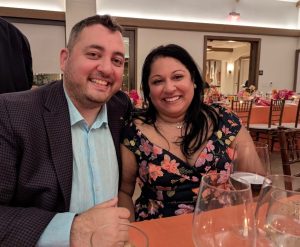
Age: 36
Town: Rotterdam, NY
Job: Lawyer
What motivated you to learn American Sign Language?
My partner, Ben. It was easy to see that ASL was an important aspect of his life. I wanted to be part of that and feel like I could connect and communicate with him even when he did not have his hearing aids in.
Had you studied it before?
No.
How has it helped your relationship?
There are practical things, like we sign during loud concerts (bonus communication – I can’t chat with my hearing friends in this setting), on airplanes (due to the pressure, he can’t hear me even with his hearing aids in), and while swimming (water in hearing aids is not fun). We sign on lazy weekend mornings while I have coffee, we both read, and Ben is on a hearing break.
Ben signs to me to check on how I’m doing in certain social settings – these are small signs that draw much less attention than asking me out loud in a group – and I love that we have this method of communication. We sign when the table next to us at dinner is saying something funny or outrageous and we don’t want to wait until the car ride home to discuss.
Ben teaches me signs all the time. Sometimes, I teach him new signs that I have learned in class and we laugh about how his sign for a particular word or concept is outdated.
Any surprises or other ways learning another language has impacted you?
I was surprised at how natural signing felt for me. Ben and I have had some tough discussions where I have switched to ASL without realizing. I am grateful for another method of communication when speaking out loud is difficult.
What is your favorite sign?
Dinosaur chicken nuggets!
Here’s a video to sign dinosaur.
Here’s a video to sign chicken nuggets.
Anything else you want to add?
I am really happy I found the CRLC and thankful for my amazing ASL teacher, Josh! In addition to teaching ASL, Josh provides information to help better understand Deaf culture and how a Deaf person may experience the world in a different way than a hearing person. I have also made a fantastic new friend through class – Jess!
Interested in learning a new language?
Check out a list of beginner and ongoing classes. You can also contact us with questions!